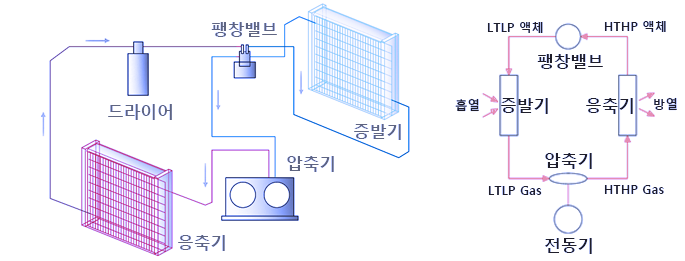
A heat pump is a device that absorbs heat from a low-temperature source and transfers
it to a high-temperature space. It is a highly efficient energy device that can be used for
both heating, cooling, and hot water supply. It extracts heat from the environment through
a cycle of compression, condensation, expansion, and evaporation of a refrigerant. Its high
electrical efficiency has attracted attention as an eco-friendly technology that can replace
fossil fuel boilers.
Composition
Characteristic
A heat pump is a device that raises temperatures by "transferring" heat from low ambient temperatures rather than "converting" electricity into heat; compared to electric boilers, it offers higher energy efficiency and reduced operating costs.
① Operating Principle
A heat pump performs both cooling and heating simultaneously by creating high and low temperatures through the repeated compression, condensation, expansion, and evaporation of a refrigerant.
② While electric heaters directly convert electrical energy into heat, heat pumps use electricity solely to "transfer heat," allowing them to produce more heat with the same amount of power.
③ Characteristics of Representative Types
- Air Heat Pump (ASHP): It is popular due to its relatively simple installation and low initial costs, but a disadvantage is that efficiency may drop at low temperatures.
- Geothermal Heat Pump (GSHP): It utilizes the relatively constant temperature underground, resulting in high efficiency and relatively low operating costs.
- Absorption Type (AHP): Uses heat (gas, solar, geothermal, etc.) as an energy source, resulting in low electricity demand; however, it tends to be complex and have large units.
④ Efficiency/Performance Indicator (COP) and Expected Effects
- Heat pumps often have a Coefficient of Performance (COP) greater than 1, which can reduce electricity consumption by 30–60%.
- A COP of 4.0 indicates a level capable of producing 4 kW of heat for every 1 kW of electricity.
⑤ Checkpoints for Installation and Operation
For air-thermal types, successful installation requires prior inspection of the outdoor unit space, noise levels, insulation conditions, and the electricity consumer.
For geothermal types, construction conditions are demanding and initial investment costs can be high, making economic feasibility studies crucial.
Application
- Hotels
- Government Offices
- Schools
- Agricultural Heating and Cooling Systems
- New Buildings
- Heat Pump Boilers


 Composition